
State government
Georgia Dept. of Community Affairs
An accessibility and performance remediation, measured before and after
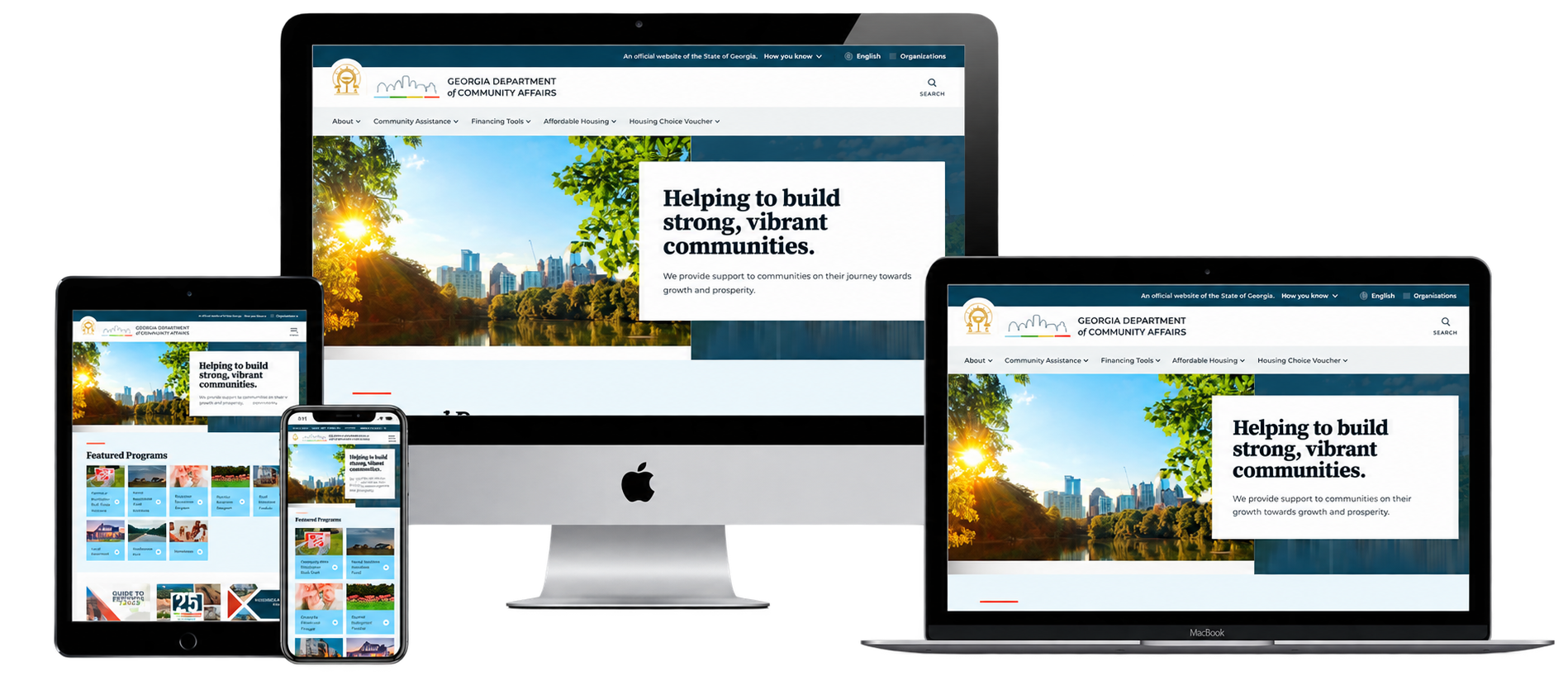
InfoStride conducted accessibility and performance assessments for the Georgia Department of Community Affairs using automated testing tools, manual accessibility validation and frontend performance analysis. Findings drove a remediation and optimization programme spanning navigation, forms, layouts, media, semantic structure, keyboard accessibility, screen reader compatibility, responsive readability, image optimization, rendering performance and frontend stability.
Client
Georgia Dept. of Community Affairs
Sector
State government
Engagement
Accessibility & performance remediation
Method
Automated + manual validation
83%
Performance score
After frontend and rendering optimization.
92%
SEO score
Alongside technical SEO and browser compatibility work.
100%
Best-practices score
With accessibility issues significantly reduced.
Key challenges
- Accessibility gaps spanning navigation structures, forms, page layouts, media assets and semantic structure.
- Keyboard accessibility and screen reader compatibility falling short of WCAG expectations.
- Responsive readability and cross-device usability problems affecting public access.
- Frontend performance and rendering stability limiting the experience on slower connections.
- No continuous monitoring capability to hold compliance once remediation was complete.
- Ensuring state housing assistance resources and public forms remain 100% accessible to all residents.
- Resolving frontend performance bottlenecks across high-traffic service and application pages.
The InfoStride solution
- Assess with tools and by hand
Automated testing, manual accessibility validation and frontend performance analysis run together — neither method alone finds everything. - Remediate the structure
Navigation, forms, page layouts, media assets and semantic structure corrected against WCAG criteria. - Fix keyboard and screen reader paths
Keyboard accessibility and screen reader compatibility rebuilt where the markup could not support them. - Optimize the frontend
Image optimization, rendering performance and frontend stability improvements across the site. - Improve reach and resilience
Responsive design, technical SEO, browser compatibility and cross-device usability all addressed as part of the same pass. - Establish ongoing monitoring
Long-term compliance monitoring capability put in place so the gains hold as content changes. - Section 508 evidence package delivery
Provided complete compliance documentation and audit reports for state governance verification.
Outcomes
What Georgia Dept. of Community Affairs has now
- Strong accessibility compliance validation achieved with significantly reduced accessibility issues.
- Improved WCAG alignment across A, AA and AAA standards.
- An 83% performance score following frontend and rendering optimization.
- A 92% SEO score alongside technical SEO and browser compatibility improvements.
- A 100% best-practices score on the post-remediation audit.
- Improved usability, accessibility consistency and responsive behaviour across devices.
- Long-term compliance monitoring capability established for continued governance.
- Full ADA Title II compliance evidence package delivered to state leadership.
More case studies
-
SUNY Geneseo
Read the case study: SUNY GeneseoA fragmented Drupal estate across hundreds of departments rebuilt as one governed WordPress platform, with accessibility enforced at…
-

The Harvard Gazette
Read the case study: The Harvard GazetteHarvard’s official news platform moved off Drupal 7 as Prime Contractor with WordPress VIP, archive and search equity…
-
TIME
Read the case study: TIMERoughly twenty-four properties across four applications – single-site, multisite, decoupled and intranet – modernized in phased batches.
Bring us your estate as it actually is
Nine CMS versions, four vendors, an open accessibility finding — that is the normal starting point. We will walk the estate with you and tell you what we would do first.